
Make Their Eyes Shine
... No, Really

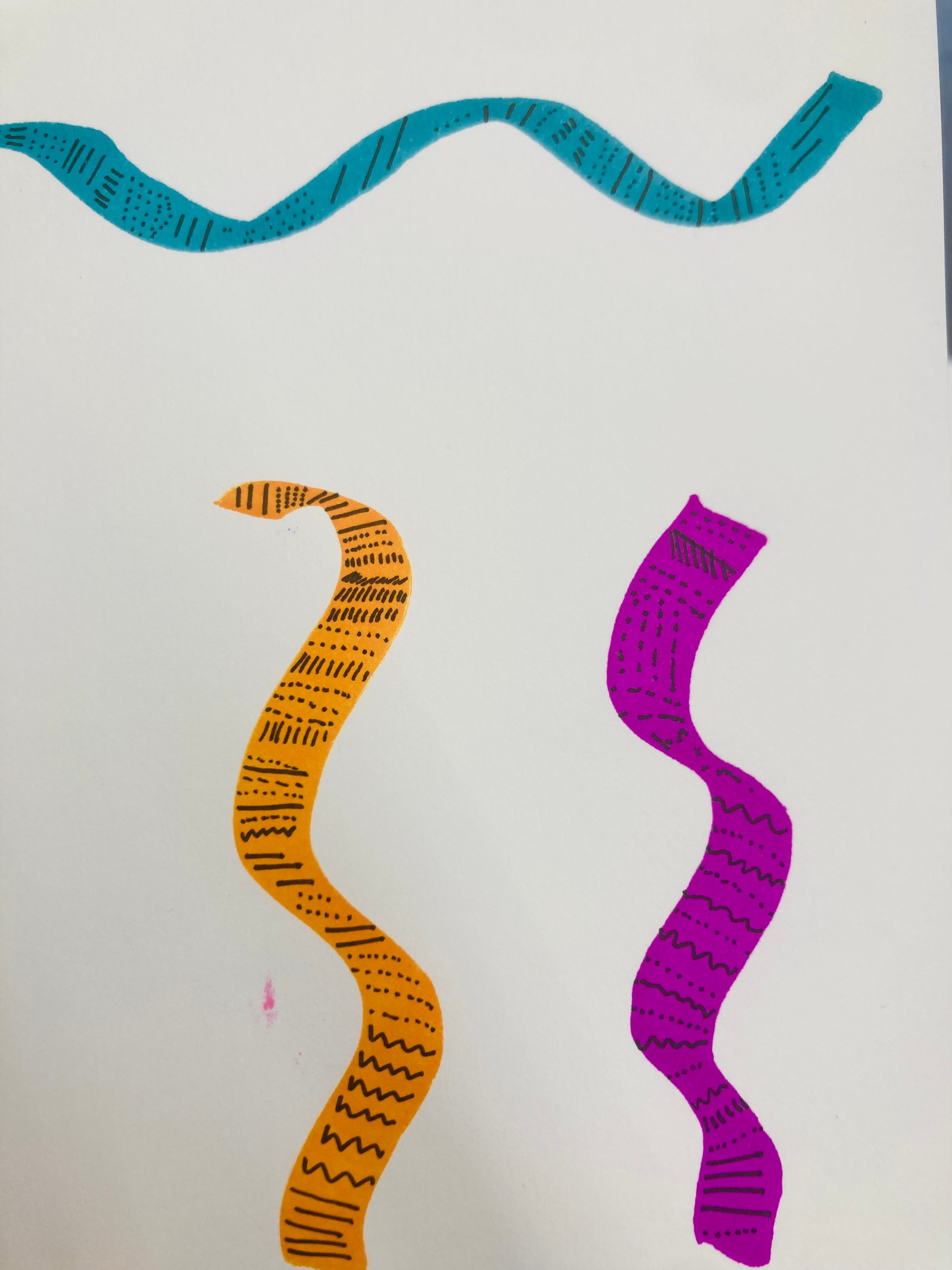
I taught a workshop this past Saturday in my hometown of Austin, TX. This image is a student piece. When she shared it on her way out the door, her eyes were positively shining.
I was thrilled.
Shining eyes has been a personal teaching metric since watching the endearing Benjamin Zander’s TED talk about the same topic. People can’t hide the eye shine. Nor can they fake it (at least not well.)
Okay. Are you waiting for me to call out the elephant in the room? Of course you are, and I am here to oblige. “Why, might you be wondering, were her eyes shining over… squiggles? To add to the confusion, these squiggles are a 30 second doodle at best.
The answer to this question is one of my favorites to answer.
It is the foundation of my illustration practice. It is what (I believe) has allowed me to gain access to large clients, working for Visa, Dell, Boston Beer, Facebook and more. As up and coming artists began reaching out to me for small consulting gigs in 2019, I was inspired to build a course about my approach to illustration. It was called ‘Intuitive Drawing,’ and in the early days, was largely confusing to most folks. To be fair, I was a little confused myself at the time.
I released an on-demand option in 2020 during the pandemic, and in spite of my learning curves, a small passionate following of people signed up. The feedback was more than I could have dreamed. Fueled by their encouragement, I began offering in-person options later than year. Those offerings were largely… Flops.
In 2021 I got pregnant, and tabled the course. I shuttered freelance and wholesale/retail in early 2024 after a few exhausting years of stubbornly trying to balance time with my toddler and part time work. In May of 2024 I got an opportunity to repurpose Intuitive Drawing for an Art and Wellness Retreat. I was over the moon. Albeit, a little concerned how it would be received.
My intuition ended up being founded. There were four art tracks at the retreat, and I was the only one that didn’t fill up. In fact, only a handful of people signed up for my session at all. The director of the program took pity on me, and roped in friends and offered spaces for free to anyone who would join my session. I was devastated… yet hopeful.
As it turned out, while people in the early years of the pandemic didn’t get Intuitive Drawing, post-pandemic 2024 people sure did. I was also more on board myself. The retreat reception was so positive, I was invited back. Courses began filling up, and I’ve been teaching more than ever in the last six months. Intuitive Drawing is now my signature offering.
As I began assertively marketing the course with my primary education partner here in Austin, they asked me to share student work to advertise the classes. I immediately cringed at the thought. Posting work is great for product driven classes, but Intuitive Drawing is the exact opposite of product-driven. Would you take a class with the above photo as a marketing image? Which brings us back to our original question:
Why were her eyes shining over squiggles?
They were shining because contrary to popular belief, “technically beautiful” art is not the essential reason art-making gives us joy. In fact, I’d argue any art product isn’t the essential reason either.
Bear with me.
Before my life as an independent illustrator I taught kids. Preschool in my early twenties, then K-4 Art. In 2010, I came to Austin to get my graduate degree in education at UT. I’ve worked with kids for decades, and now I live with one. Our son is three, and anyone with a toddler is going to vouch for what I’m about to say next:
Children before the age of 6 give literally no shits about beauty. They also think nothing of product in general. Give a small child a pile of paper and you’ll see this lack of preciousness in action. My son can draw fifty drawings in fifteen minutes if you let him. That is an impressive ratio. Over years of studying how children make Art here’s what I believe:
The original reason we made things was not about the THING at all. It was about US. Small children make things to come home to themselves. To regulate their nervous systems. This is especially true for sensitive kids.
The other day my kiddo and I were on a playdate with a friend. Her kiddos were spatting with one another. Braeden slowly walked the periphery of the playground, calmly strumming a stick he found like a guitar. My friend took notice: “Gosh, your kid is so calm.” I thanked her, but noted in my own mind that he was most certainly overwhelmed and regulating. Sometimes it’s not this dramatic, but I believe creating is always done by young children because it feels excellent in their bodies. It’s why they simply don’t care how the work turns out. I’ve watched Braeden strum soup cans like a guitar, and he’s never asked me for lessons. The joy is in the way the Art makes back on him.
Artwork is an avenue to making something far grander than any lump of clay, stretch of canvas, or sheet music could provide…
The Art isn’t the Drawing. The Art is YOU.
Here’s the excellent news about this realization when we have it: We don’t lose this capacity as we age. It merely goes dormant. Our Inner Art Kid with Shiny Eyes is a force for sure, but still tiny nonetheless. If your critical pissed off Adult Artist tells them to “Sit Down and Shut Up, You Are Making Beautiful Shit Thankyouverymuch…” they will oblige. They will however, never stop being ready to make messy, “ugly” stuff that feels amazing. Like any adult to a child, you simply need to permission them.
When people take courses with me, we walk through experiences that reconnect Art Adults to that Art Kid. We lean into a drawing practices that patiently, gently, persistently nudge people towards the type of drawing they most wanted to do as children. What is your favorite mark? What Elements of Design are so luscious for you, you’d draw them even if no one saw it? These sound like simple questions, and yet when adults lock into the drawing style that creates somatically back onto their systems… pure, unbridled joy is unleashed. Here’s how you know your Inner Art Kid is on the loose, you will give no shits what people think.
It is why squiggles made her eyes shine. It was hers. It was sincere.
You know what else is sincere? My three year old. Have you heard an adult look at a child’s drawing (or abstract expressionists at the museum) and say: "I Could do That?” When I took kids to the art museum as a public school teacher I heard it from parents all the time. What I’d say now to anyone who says this: Okay Do it. Try it. I guarantee if you try to copy my three year old’s drawing you might come close but it will not feel the same. And why?
Because yours will be insincere.
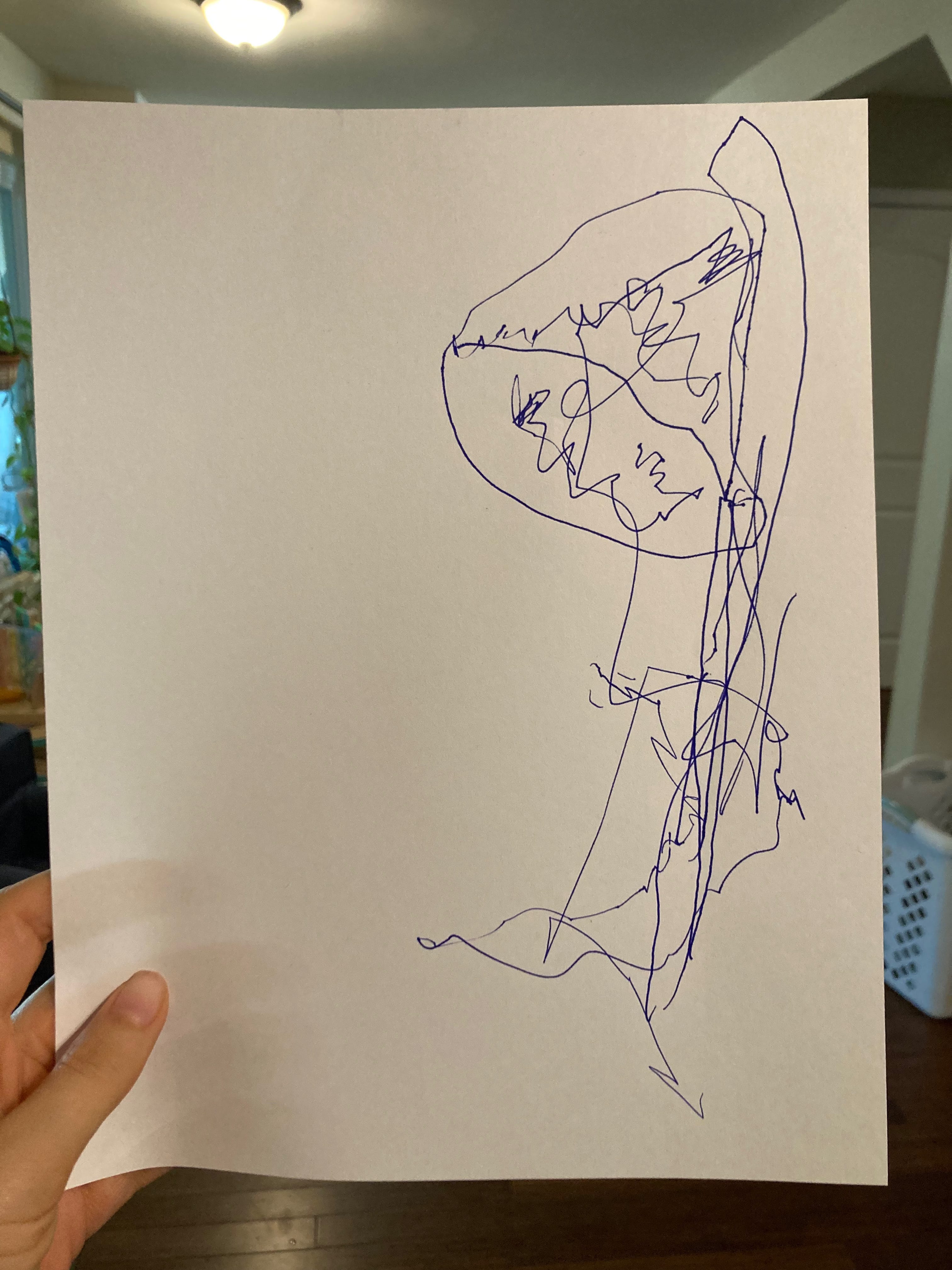
Sincerity is elusive. If we try to make sincere work, like a butterfly it’s off in the breeze. If we simply yield to what our bodies say, it alights on our hand easily and joyfully. Sincerity is hard to explain but easy to feel. If you try and splatter like a Jackson Pollack and compare the yours with his, you’ll see what sincerity is in the contrast. Even if we are inspired by him, we all must learn to “splatter like ourselves.” When people create in their most authentic way, even the most inexperienced consumer can sense it. They gravitate to it like a moth re: flame.
Sincerity is what most fledgling independent artists struggle with. They learn early on to draw what sells and impresses. This was my story too. I got a B.A. from Kent State in the late nineties, and took lots of Fine Art courses teaching tools and techniques of representational drawing. I got very good at it. If I had kept pushing over the next twenty years I would have sold them and started a business with them.
And I would have hated every second of it.
For all my struggles in this earth game, one thing I’m proud of is my absolute allergy to inauthenticity. I’ve never lasted long at being anything but myself. That said, I have gone dormant for long stretches trying to figure it out. By my late twenties I stopped drawing altogether. I didn’t know why, but I knew it felt right at the time. I wouldn’t draw a single thing for nearly five years.
Enter grad school at 30 years old. I took a class entitled get this: Management in the Arts. It was a business class in the University of Texas Art School, so imagine my surprise when on day one we learned 40% of our grade was to keep a semester long art making practice and present a portfolio during finals week. I was petrified. Drawing the way I had learned in my undergrad made me nauseous to think about. The professor was jovial about the whole thing, and chuckled as he said: “Bring in pencil drawings on napkins for all I care,” but do it daily.
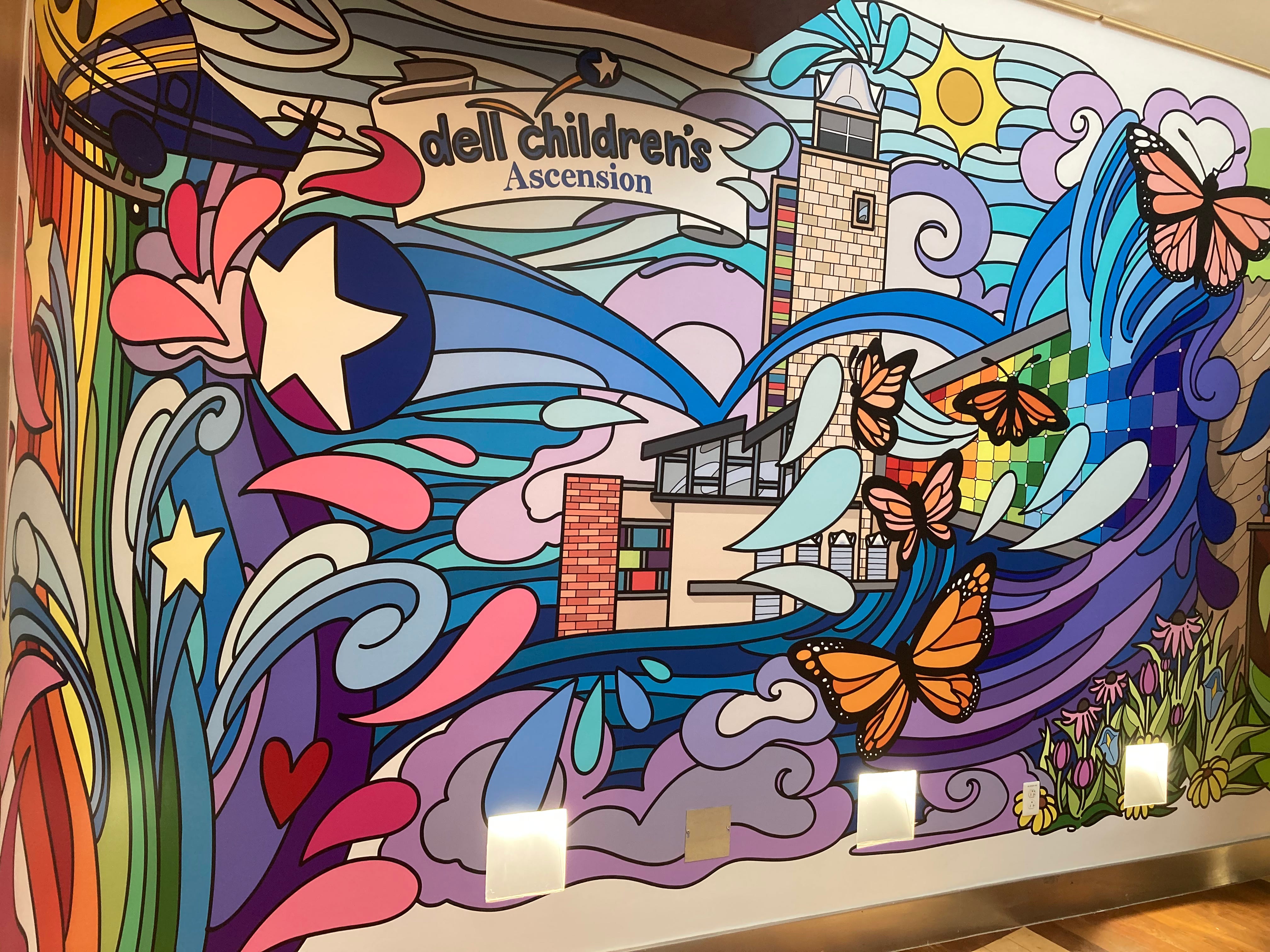
And his statement right there did the thing my Art Adult hadn’t been able to do for nearly a decade. This PhD in Art Education, who was widely published and tenured at an R1 university, gave my cranky Art Adult permission to yield to my Kid. That night I went home with black pens and paper. I turned on a movie and doodled all night in bed. I had no end in mind. I worked in ink that couldn’t be erased, and forced myself to reckon with errors organically. I loved every single speck of it. The last time I had drawn so freely I had been 17 years old. It was a true homecoming. My life was transformed forever. The processes of that time period became the foundation of my practice today. I drew this way in bed as a grad student, and with Dell Children’s hospital on their entryway mural.
This style is arguably less rigorous than the representational compositions of my youth, and yet infinitely more sincere. It is not for everybody nor should it be. I still know very little about art business. Yet one thing I know for sure, is I would have lost the race before the gun went off, had I created an art business doing anything less than work that made my eyes shine.
This flies in the face of much of what we’re told about being great at something. Being great is supposed to be hard. We are supposed to struggle. We’re supposed to not like it. There should be grit in there for good measure. I have students in most of my classes ask me about this: “Do you think there’s a place for struggle and doing stuff you don’t like?”
Absolutely.
My work today was absolutely formed and shaped by the years of rigorous technical skill building. Here’s what I say to them, and this might be controversial: The grit and struggle is not the ends. Grit is only the means, and the ease and joy is the ends. Put another way: The work should always be shiny eye inducing. Always. I believe this in the depths of my being. How we support our work, how we get it out there, how we develop it, how we support it… that needs struggle. But I truly think the actual work is supposed to be like a three year old at a sketchbook.
The culture has you believing otherwise, because the culture doesn’t want sincerity it wants commodity. In some ways this used to depress me, but in other ways it’s excellent news for artists who realize the charade. In a culture full of artists making things to sell, those making sincerely are standing out like never before. This has also never been more true in the dawning age of AI.
It used to be that commercially driven artists beat the intuitively driven ones every time to the punch. I believe that is no longer true. I believe the era of authenticity is upon us. Some might think nothing could be further from the truth. I won’t argue with you on that point. I will say however, that for many of us, we have just simmered in social media soup for two decades. We have absorbed hours of regurgitated content, and creative works literally only meant to hack an algorithm. We are so starved for sincerity and intuitively made things, that like the parched in the desert we now see it with more clarity than ever in history.
If you have needed a permission slip to make your own eyes shine… I hope you take this one from me. If you want to stay connected as I build an online Intuitive Drawing class, you might consider subscribing.
Well, this is just great! Thanks for directing me to it. I'm interested in your intuitive drawing. I've been developing, or perhaps, finding and losing, what I call 'the free line', most of my life. In my writing here I'm tracking the evolution of my 'no pencil first, no planning' improvisatory approach. I sometimes think of it as making the best of my impatience to make something happen, but I also know that I've always been interested in what comes out when we 'look the other way' and play, rather than try....