
A Case for Things Being Better Than They Seem...
An Art Ministry Post

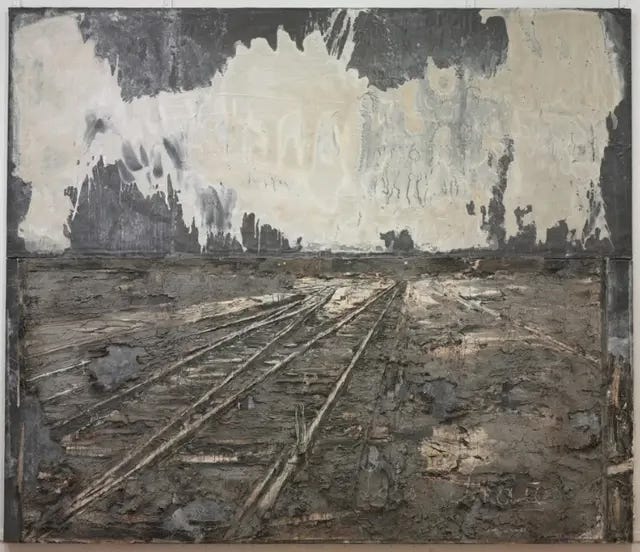
I have a thought experiment.
It’s an odd one, but if you’ll humor me, I (hope) it might make a case for comfort in these uncertain times.
This artwork is Lot’s Wife by Anselm Kiefer in the Cleveland Museum of Art’s permanent collection. It’s a neo-expressionist homage to the Holocaust and Kiefer’s German roots. A mixture of salt, oil, ash, lead and plywood, it’s as dark and gritty as the historical event it portrays. Kiefer’s pieces are often painted with acid. The docent I first toured this painting with would come into the gallery some days, to find a portion of the artwork decomposed onto the floor… an intentional part of his work.
Imagine you live in this piece. (This is the experiment part).
Imagine you are a chunk of ash. It is a soothing existence. Not because ash is a particularly soothing thing to be, but because you are surrounded by similar materials, colors, textures, little contrast, and little range of tone. Monochrome in art is often intentionally used by an artist to create a feeling of calm. Not that the Holocaust is a calming event in the slightest but I’d offer in this instance, a “desolate” feeling might be considered on the low frequency end of calm.
Now imagine one day you wake up and you are not gray ash. You have become a vibrant rose colored creamy swash of saturated acrylic paint. Suddenly you don’t fit in, and along with your “fitting in-ness,” out goes your feeling of safety. You look around the artwork for the first time notice darkness. Not because the darkness didn’t exist before, but because now in contrast to you, it is more noticeable. You feel scared.
The next day you wake up and have transformed again! This time you are not a rose. Now you are a neon pink watercolor… even brighter than before, and also translucent. Not only do you feel scared, but you feel ineffective, because you are partially see-through. Everything around you is opaque and dense. Your translucent brightness feels out of place and weak in an artwork like this.
This formerly easy painting for you to live inside, has now become positively terrifying. Not surprisingly you have no easy answers to how this happened, and the fear spiral keeps going and going.
Here’s the thought part:
What if the reason you’re scared isn’t because things are getting darker? What if it’s because you are getting brighter?
Contrast is a Principle of Design used in Art. It is used in visual Art, but also in Music, Poetry, Film, Sculpture and more. It is primarily used by artists to direct people’s attention. Dark next to light. Loud next to soft. Vivid next to subdued. Big next to small. Our eyes and ears go right to these areas quickly and naturally. It is how artists move our senses around a work in the desired way. A gorgeous use of this in music, is Igor Stravinsky’s ‘Rite of Spring.’ In fact, his use of musical contrast was so jarring and unprecedented, people walked out of early performances of it.
You could argue the Kiefer has contrast in the sky with the dark and white swashes, but even those seem to retreat into the overall gloom of the piece. The perspective of the narrowing rails as they descend into the distance draws the eye, but generally nothing is particularly out of place. The piece feels low contrast, haunted and… dead. Everyone experiences art differently, and who the heck am I to write about Kiefer’s intentions? Still, I’d say it would be a stretch to call this work high contrast and grabbing. To most I’d imagine this piece feels dull and muted.
Now suddenly in our thought experiment YOU- the little dab of ash- are transformed to rose and positively bursting with contrast to your environment. As a dusty piece of ash you used to fit right in. Now you’re very different, and that difference draws your attention to the contrast (and the darkness) like it never did before.
This might be an excellent metaphor for what we’re living in right now.
Of course, this whole post is only an invitation. If it does feel right in your bones, I’d repeat: Maybe things aren’t getting darker around you. Maybe you’re just getting brighter. Maybe most of us are getting brighter, and suddenly like Contrast is wired to do, our attention is pulled right to the darkest spots of our shared life on planet earth. Not because the darkness pulls attention by itself, but because next to increased brightness there is tremendous contrast.
It is the contrast that pulls our attention, not simply the dark by itself.
I feel fairly certain all of you reading this are artists. Maybe not in the professional sense, but if you’re here, you are an artist in your heart. Heck, I believe everyone is an artist, but most simply don’t believe it anymore. If you are one of the lucky ones to remember your artistic birthright, you might analytically understand the idea that we are all one. It’s a beautiful idea, but can be challenging to concretize using the mechanistic model we currently reside inside.
For example if you’re sitting at home painting in a safe, cozy art studio, while thinking about children in Gaza, you might feel like a piece of sh** for not “doing anything.” There’s this idea in our culture still, we must ‘be in the streets screaming’ to affect real change. Those things have their place, and if that’s your calling I am grateful to you. This world needs that. I would also offer however, that’s not the only (or even primary) way change manifests in an artwork, (and subsequently in this metaphor, the world.)
Change in an artwork is instant. For the things living in the work (in this case, US), it doesn’t feel that way. However, if we could zoom out to be a viewer of all humanity, just like an artwork, we could conceive its entirety and therefore all the connections.
To explain another way: What if you’re in a Target checkout line in Ohio, and you play with an exhausted mother’s toddler for a few minutes while she pays? Can you open to the idea, that you are changing the energy in Australia? You’re just in the work so you can’t see the way your input shifts the whole piece.
Toni Morrison said years ago:
“This is precisely the time that artists go to work.”
She was talking about artists and their creative works during times of darkness, and I’m pushing her idea to include energetic creations as well.
You aren’t just changing the world by your physical art (although of course that’s true). Your life and creations have a frequency. That energy shifts the entire planet’s artwork immediately, just as the rose swash shifts the Kiefer.
This isn’t about privilege now. At least not only privilege. You might argue those with more resources, are better poised to affect this kind of change, and that is (sometimes) correct. It depends on the artwork. An orange circle in one painting does one thing, and an orange circle in another painting, does something else.
The stressed out, independently wealthy painter living in a posh Manhattan studio might be affecting less contrast to the earth canvas, than say a single mother of three, lovingly taking five minutes before bed to paint with her children. You can see from these two examples how all of us can be both of these extremes and everywhere in between. Or flip and reverse it. The machine wants you to think I’m slamming on the posh artist and bolstering the single mother. What I’m saying is that in an artwork those labels mean nothing. It’s their energy that has meaning.
The task before us now I’d argue, (if this is true, and I think it is), is not to make better things on our planet.
It’s to be more of the energies we say we want.
We are artworks living in an artwork, but we the culture is still positively obsessed with this idea we live in a machine. This is why artists in particular feel guilt (or even worse shame) for sitting in the quiet privilege of their creative lives when the world is on fire. Here’s what I most want to impart in this post:
Improving the earth artwork isn’t about the what. It’s about the how. It isn’t about the object, it’s about the frequency.
When we create on an ‘earth canvas’ we’re not painting with physical materials. We are painting with energetic ones. Once years ago I went to a protest with a young woman who had very similar political beliefs to me, and I watched her call people terrible names. She had fallen into the machine. She thought her input was her perspective on politics, when in fact it was her energy… and her energy was quite frankly, terrible. This can be true of anyone in any party, and it’s why more and more people are distancing themselves from the idea of sides. From this vantage point you don’t need to be working at the ACLU, in Washington, or painting about social justice (although you absolutely can do those things, too.) This is a both/and.
It’s a difficult segue. The Kiefer isn’t a “bad work,” and I’m sure some of you reading this one wonder if I’ve been framing it that way. Kiefer’s work changed my young life. It’s gorgeous. I first saw it age 15 and I never stopped thinking about it. I’m using the Kiefer/ rose swash as a metaphor to consider our experience in these human bodies less mechanistically and more artistically.
The only reason the rose swash metaphor works in this post, is because the ash gray exists. In that way, the ash is just as beautiful. If you want to experience rose in an artwork, something opposite has to show up. If the Kiefer painting was all rose, the new rose simply disappears. If you want to experience goodness in this world, something or someone opposite, similarly, has to show up. Contrast brings attention. Contrast shows you things. Contrast lets you see yourself. If all of us are brightness, we turn into candles in the sun. Shiny sure… but who gets to know themselves that way?
Maybe you’re wondering if this is where I say “everything bad has a good side” or insert some other banal platitude. It is not, although I can see why you might be poised for me to go there. I’m saying that contrast just IS. Contrast is where we direct our attention. Maybe the struggles of the world aren’t getting our attention because “evil is winning” or whatever the talking heads online want us to freak out about. I’d say that the world is getting our attention because more than ever in history, the contrast is shifting higher. Contrast is scary to experience when you’re IN THE WORK, but from the outside the work, I’d say our planet is looking more and more like what we say want.
The work’s frequencies are brighter than ever, and therefore the darks seem darker than ever.
This gives me tremendous comfort, and this post was an opportunity to give comfort to you if you’ll receive it. Please consider passing along or sharing your thoughts. I love to read them.
Nice!
Wow, beautifully written. The visual of dark ash becoming bright acrylic paint will probably never leave me. It represents our phases in life. Evolution 🩶
I focus on parenting insights, would love to connect with you :)